
Our goal is to offer every course every term, but sometimes factors like faculty availability, student course rankings, and program enrollment keep us from reaching that goal. If you’re concerned about needing to enroll in one particular course, please contact us!
CET Colombia Study Abroad
CET Colombia: At-A-Glance
Study race, ethnicity, and identity
Spanish language electives
Live with a Colombian roommate
Direct-enroll electives
Traveling Seminar to the Caribbean coast
Out-of-class learning and assignments
Fall
- Arrival: 07/19/2027
- Departure: 12/05/2027
- Recommended Credits: 15–18
- Fee: $17,990
- Application Deadline: April 1
SPRING
- Arrival: 01/24/2028
- Departure: 06/10/2028
- Recommended Credits: 15–18
- Fee: $17,990
- Application Deadline: October 1
Fall
- Arrival: 07/19/2027
- Departure: 12/05/2027
- Recommended Credits: 15–18
- Fee: $17,990
- Application Deadline: April 1
SPring
- Arrival: 01/24/2028
- Departure: 06/10/2028
- Recommended Credits: 15–18
- Fee: $17,990
- Application Deadline: October 1
CET Colombia study abroad students examine race, identity, and ethnicity through the Afro-Colombian lens in Cali—a city with the second largest population of African descent in South America. The program’s curriculum, developed in consultation with Howard University, delves into these dynamics through sociopolitical, economic, artistic, and historical representations of race in Colombia. And with out-of-class learning, local roommates, and direct-enroll classes that put you in a Colombian classroom, you grow your understanding both intellectually and experientially.
Academics in Colombia
Semester
Snapshot
- Pre-requisites: None
- Electives in both English and Spanish
- Traveling Seminar to San Basilio de Palenque and Cartagena
- Spanish language classes
- Direct-enroll electives for intermediate and advanced Spanish speakers
- Host University: Universidad Icesi
Curriculum & Syllabi
All levels of Spanish speakers are welcome at CET Colombia, but your proficiency level (as decided by the program’s language placement exam) determines your curriculum.
BEGINNER & INTERMEDIATE 1 SPANISH
Students that place into Beginner and Intermediate 1 levels of Spanish take one core course, a Spanish language course, one Icesi course, and two electives to meet the total 15 to 18 recommended credits.
Core Course
You take this 3-credit course that is taught exclusively for CET students. This course is initially taught in English, but as your language skills improve, your teachers introduce more Spanish instruction.
CA/SOCI 330 Race and Identities: Debates in the Colombian Context
Spanish as a Foreign Language
You take this 3-credit course taught exclusively for CET students.
Icesi Coursework
You take this 3-credit course taught exclusively for CET students in English at Universidad Icesi:
The Political Economy of Anti-Black Racism in Améfrica
CET converts final grades from the local host universities to US letter grade equivalents.
Electives
• Beginner-level Spanish speakers take two CET electives to meet the total recommended credits.
• Intermediate 1-level Spanish speakers take one CET elective (taught in English or Spanish), and add one direct-enroll course at Universidad Icesi to meet the total recommended credits.
CET Electives
CA/ANTH 330 The Cultures of Afro Descendants in Colombia (taught in Spanish)
CA/CLTR 340 A Social History of Colombian Coffee
CA/GEOG 310 Environmental Conflicts, Territorialities, and Ethnic Groups in Colombia
CA/POLI 320 Reclaiming Blackness: Social and Political Movements in Colombia
CA/SOCI 315 Crime & Justice in Colombia
Direct-Enroll Electives at UNIVERSIDAD ICESI
- These are elective courses taught at one of the program’s host universities, Universidad Icesi. Most classes are 3 credits each, taught in Spanish (unless otherwise noted), and offer the opportunity to learn alongside Colombian undergraduates and learn as local students do. To enroll in Spanish-taught courses at Universidad Icesi, students must have achieved B1–C1/Intermediate through Advanced Spanish language proficiency on the CET language placement test. Course offerings differ each semester, but CET students have full access to Icesi’s undergraduate courses, provided you meet any specific pre-requisites. Examples of direct-enroll courses include:
- Society and Conflict
- Audiovisual Communication
- Film and Gender
- *CET converts final grades from the local host universities to US letter grade equivalents.
INTERMEDIATE 2 & ADVANCED SPANISH
Students that place into Intermediate 2-level Spanish or higher take one core course and a mix of CET electives and direct-enroll electives to meet the total 15 to 18 recommended credits.
Core Course
You take this 3-credit course that is taught in English exclusively for CET students.
CA/SOCI 330 Race and Identities: Debates in the Colombian Context
Electives
• Intermediate 2-level Spanish speakers will take one CET elective, one Spanish language course, the CET x Icesi course, and one Universidad Icesi direct-enroll course (taught in Spanish) to meet the total 15 to 18 recommended credits.
• Advanced-level Spanish speakers take two CET electives and two courses at Universidad Icesi (the CET x Icesi course qualifies) to meet the total 15 to 18 recommended credits.
CET Electives
These 3-credit electives are exclusively for CET students in English or Spanish.
Area Studies
CA/ANTH 330 The Cultures of Afro Descendants in Colombia (taught in Spanish)
CA/CLTR 340 A Social History of Colombian Coffee
CA/GEOG 310 Environmental Conflicts, Territorialities, and Ethnic Groups in Colombia
CA/POLI 320 Reclaiming Blackness: Social and Political Movements in Colombia (taught in Spanish)
CA/SOCI 315 Crime & Justice in Colombia
Spanish Language as a Foreign Language
CA/LANG 250 Spanish as a Foreign Language (Intermediate 2)
CA/LANG 300 Spanish as a Foreign Language (Advanced 1)
CET x Icesi Coursework
- This 3-credit course is taught exclusively for CET students in English at Universidad Icesi:
- The Political Economy of Anti-Black Racism in Améfrica
- *CET converts final grades from the local host universities to US letter grade equivalents.
Direct-Enroll Electives at UNIVERSIDAD ICESI
- These are elective courses taught at one of the program’s host universities, Universidad Icesi. Most classes are 3 credits each, taught in Spanish (unless otherwise noted), and offer the opportunity to learn alongside Colombian undergraduates and learn as local students do. To enroll in Spanish-taught courses at Universidad Icesi, students must have achieved B1–C1/Intermediate through Advanced Spanish language proficiency on the CET language placement test. Course offerings differ each semester, but CET students have full access to Icesi’s undergraduate courses, provided you meet any specific pre-requisites. Examples of direct-enroll courses include:
- Society and Conflict
- Audiovisual Communication
- Film and Gender
- *CET converts final grades from the local host universities to US letter grade equivalents.
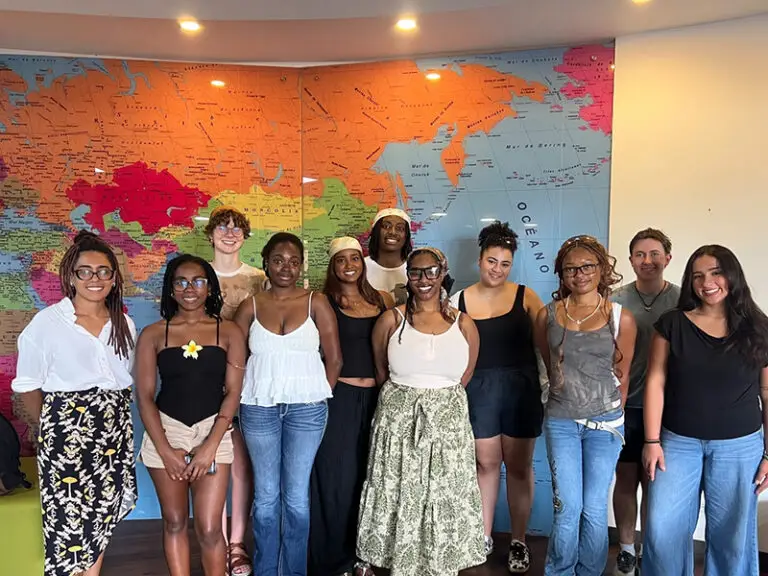
Dive Deep into Colombia
Experiential learning in Cali. As a city that celebrates Blackness as one of its defining features, Cali is the perfect home base to explore race, ethnicity, and identity, both in and out of the classroom. Depending on your electives, you might examine the consequences of illegal mining on a visit to Farallones National Natural Park. Head to a coffee farm and speak with producers about women’s leadership in the field, market access, and sustainable agriculture. Or even host Proudly Afro-Colombian: A Discussion Series by facilitating a public discussion with prominent artists, scientists, and activists.
Spanish language immersion. Get ready to challenge your Spanish skills like never before. Navigate life in a city that speaks English minimally, take a Spanish class, and—for more advanced speakers—study alongside local Colombian undergraduates with direct-enroll coursework at Universidad Icesi.
Traveling Seminar: Comparative Learning
Take learning on the road with seven memorable days exploring concepts from your core course in San Basilio de Palenque and Cartagena. You might:
• Stay with a host family in Palenque, a maroon settlement with a long history of resistance and resilience. Learn about customs, traditions, and daily life, then help out with a communal project.
• Learn about the local, no-police justice system from La Guardia Cimarrona and community elders.
• Attend a ballroom workshop to examine Afro-Colombian identity and self-love as resistance in the colonial city of Cartagena.
• Canoe through La Boquilla’s mangroves with locals. Participate in a traditional fishing workshop focused on ancestral practices, and learn about how rapid-growth tourism has impacted livelihoods dependent upon fishing.
Housing and Meals
- Apartment in student housing building
- Off-campus housing
- Share a unit with CET peers & local roommates
- 4 people/apartment
- 1 person/room
- Fully equipped kitchen, bathroom per 2 students, dining area
- Wifi, bed and bathroom linens, basic furnishing, A/C in the common area, electric fans
- Shared laundry room, BBQ area, study room, gym, game room, pool area
Living Like a Local
Local roommates. Want to find out where’s the best champu (refreshing drink with pineapple, lulo, and orange leaves)? Which restaurant to eat at in Parque del Perro? How to navigate the local bus system? Sharing your apartment with a local university student gives you insider’s access to the city and brings language and local culture out of the classroom and into your home life. Learn more about living with a local roommate.
Eating in Cali. For meals, take your pick of Cali’s many inexpensive eateries. Find your favorite arepa spot or savor a bowl of sancocho, a hearty soup made with chicken, potatoes, plantain, herbs, corn, and avocado. Feeling like a home-cooked meal? Grab ingredients at the supermarket and have a big night in with your roommates. Learn more about accommodating your dietary needs in Cali.

Life in Cali

- Known locally as: Cali
- Population: 2.3 million
- Local Currency: Colombian Peso
- Known for: Salsa capital of the world, 2nd largest Black population in South America, beautiful views and nature, Cristo Rey, Festival Petronio Álvarez
In a city where the influences of diversity are ever-present, your everyday surroundings will inform your studies, and Cali’s active calendar of cultural activities will fill your days. Go dancing at Calle de la Salsa, a community salsa event at Boulevard del Río. Listen to live music and peruse local artisan works at Loma de la Cruz, or visit the San Antonio neighborhood to listen to storytellers. Need a reset? Take a swim in one of the many rivers across Cali—a favorite weekend pastime of Caleños.
Experience Cali and Colombia with CET
Around the city. Each term, the program offers different extra-curricular activities that allow you to explore Cali and Colombian culture. Try your hand at salsa with a workshop in the city’s iconic Obrero neighborhood. Relax at a movie night or beat the heat with a refreshing cholado (a fresh fruit salad with condensed milk served over shaved ice). In the fall, attend the Petronio Álvarez Pacific Music Festival, the biggest Afro-Colombian music and culture festival in the country.
A Weekend Away. Head to San Cipriano, a nature reserve with a small Afro-Colombian fishing village along the Danubio River. Meet with locals to discuss how tourism impacts their community, then learn about collective land rights and ancestral practices that continue today. Plus, relax with a hike to a waterfall and and a dip in the river.
Volunteer in Cali. Consider giving back to the community with a 4 to 6 hour weekly commitment. You might help a women-led organization increase access to education or help strengthen community organization in the city’s most vulnerable areas.
Every program tells a story
See Colombia through the eyes of students and staff.
Student Resources
"The day ended with a deeper appreciation for how local communities are actively protecting their land and water while building sustainable livelihoods. Leaving Montebello, I felt both physically refreshed from the river. I was energized by the connections between our coursework and the realities on the ground."
— Aina Bandele,
George Washington University | Fall student
READ AINA'S BLOG— Aina Bandele,
George Washington University | Fall student
"As a sociology student planning to enter the field of social work, I consider it my business to understand cultures foreign to my own. CET Colombia focuses on race and ethnicity in Colombia, with classes on Afro-Colombians and how blackness factors into the culture of the people of Cali. Learning about these issues from the people who actively live them is invaluable in my career.
— Sam Lambert,
Berea College | Spring student
READ SAM'S BLOG— Sam Lambert,
Berea College | Spring student
"Language study at CET Colombia is so rewarding. I started with no Spanish. Now, I am at a level of practical intermediacy. I have made friends and met with professors in Spanish, despite having never taken it before this program."
— Noah Rowan,
Clark University | Spring student
— Noah Rowan,
Clark University | Spring student
"As much as I have been missing home, it has been fun to spend time with the people of CET—including our lovely Colombian roommates. They have all been very helpful from helping me find the best grocery store to making sure I am feeling supported to inviting us to do random activities like a rollerblading class."
— Magdalena Poling,
Carleton College | Fall student
READ MAGDALENA'S BLOG— Magdalena Poling,
Carleton College | Fall student
"During my time abroad, I delved into the study of race, identity, and ethnicity through the Afro-Colombian perspective in Cali—a city with the second-largest population of African descent in South America. I had excellent professors who taught me so much."
— Ashari James,
Howard University | Spring student
— Ashari James,
Howard University | Spring student
"People would often ask what we were doing in Cali, and would start conversations with us! And, for our beginner Spanish speakers, people were often so excited to hear that students were interested in learning the language! In short, romanticize the places you are in and treat every location like a destination to get the most of it."
— Jasbeth Medrano,
University of Texas at San Antonio | Spring student
READ JASBETH'S BLOG— Jasbeth Medrano,
University of Texas at San Antonio | Spring student
"Though folks in the program had been taking trips around the country independently from the study abroad program, the Traveling Seminar was the perfect opportunity to spend time as a collective while furthering our understanding of how the Afro-Colombian experience varies by region."
— Karen Garcia-Ramos,
Pomona College | Spring student
READ KAREN'S BLOG— Karen Garcia-Ramos,
Pomona College | Spring student
Explore more resources:
On-the-ground support
Navigating a new city, country, and culture is a big challenge worth taking—and we’re here to help you along on this adventure. Our on-site team is bilingual, thoughtful about guidance and support, and is passionate about sharing their love of Cali (and Colombia!) with you.

Program Fees
Fall/Spring
$17,990
What's Included
Tuition
All of your classes and program-related learning are included with your tuition.
Housing
We arrange your housing in a fully-furnished apartment. Your program fees go toward rent, utilities, furnishing, and other management costs.
Traveling Seminar
We cover your transit, housing, and most meals during your Traveling Seminar to Cartagena and Palenque.
Activities & Excursions
The activities and excursions that we arrange are included in your program fee.
Staff Support
From pre-departure to orientation, from on site to re-entry, CET provides you with the support you need every step of the way.
Insurance
You’re provided with a comprehensive insurance plan that even includes medical evacuation coverage.
Visa Support
We guide you step-by-step through the visa process. Most nationalities (including US citizens) can receive a visa exemption on arrival at the airport, and we’ll help you finalize your status on-site to cover the full program dates.
Course Materials
Your textbooks and course supplies are covered and waiting for you on site.
Transcript
At the end of your term, you’ll receive academic documentation as proof of all you’ve accomplished abroad. Depending on your home institution, you will either get a CET grade report or a School of Record transcript from the University of Minnesota.
More on finances
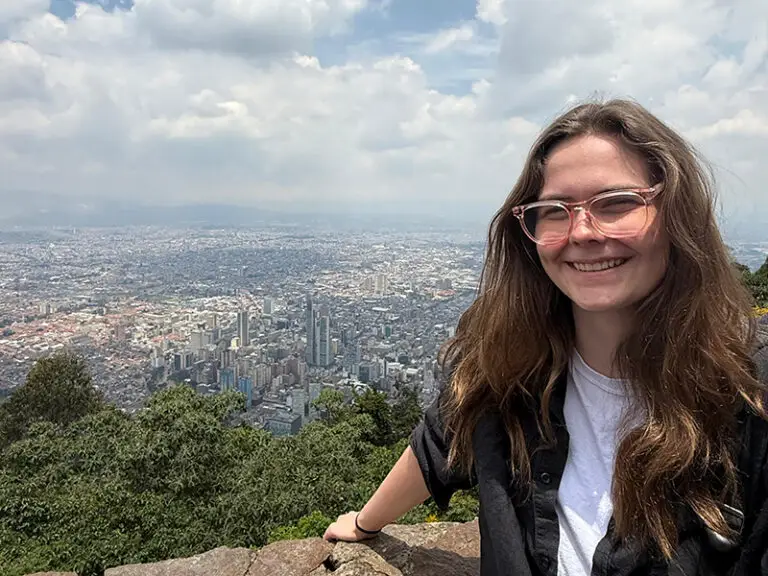
Program fee breakdown. Of the total program fee, $13,493 goes to tuition and fees, and $4,497 goes to housing and other student life fees.
Local cost of living. The cost of living in Colombia is lower compared to that of the United States. Monthly groceries for one person in Cali is around 150 to 200 USD and a lunch at a casual eatery is around 7 to 10 USD. Bus rides are about 1.50 USD, and the average cost of an Uber ride is 10 USD.
Estimated out-of-pocket expenses:
- Round-trip Airfare: $950
- Meals: $2,200
- Personal Expenses: $1,200
View the CET Colombia budget sheet for a more detailed estimate of costs.
additional resources
How to Apply
Eligibility
- • Pre-requisites: None. Open to students of any Spanish level, but students with more Spanish language experience have more curricular flexibility
- • Must be 18 or older at the time of program participation
- • Open to students from any US college or university
- • GPA: 3.0 or higher is recommended, students with lower GPAs will be asked for a faculty recommendation to supplement their application
Online Application Form
This is a brief form that asks for basic information and has a few short answer questions about why you want to study abroad.
Passport Information
Upload a scan of your passport to your CET Compass account. This should be a single scan that includes the signed signature page and the photo/personal details page. Don’t have a passport yet? Let us know and we can help advise you.
Study Abroad Office Recommendation
This is an online form that your study abroad office completes to let us know you meet the requirements to study abroad. To send the electronic form request, simply enter the name and email address of your study abroad advisor in the designated fields of your CET Compass account.
Official Transcript
Your CET Compass account has specific instructions for submitting an official transcript.
Application
Deadlines
Spring Semester:
November 1
Fall Semester:
April 1
Have a question? Get in touch!
Gabrielle Jackson
Manager, Student Services
202.315.0238
[email protected]
Price Subject to Change:
CET reserves the right to increase quoted charges at any time without prior notification, based on increased instruction costs, exchange rate fluctuation, or other cost increases beyond CET’s control.