China

Toggle view

晓说 or Char Chats in Chinese: The Travel Edition

Bookmark and Share
Written by Charlotte Steiner (Middlebury College), Student Correspondent
China, Hangzhou

Traveling. Is. The Best. Yes, I know I’ve harped on it before. But I’ll say it again anyways: it’s so worthwhile and rejuvenating to get out and around. Going someplace new, I feel as I did when I first got here—excited and thrilled at the very fact that I’m in China. Case in point—our group trip this past weekend. While the Middlebury/CET program is certainly a grueling academic program (as our mountains of daily homework kindly remind us), we are also provided with a number of opportunities to explore China. In fact, CET gives us two weekends off (in addition to spring break) for school-sanctioned/organized trips.

China, Hangzhou, chop, cooking, food
This past weekend felt a little like summer camp, or like those long ago elementary school overnight trips to places like Jamestown and Williamsburg. Or maybe it was more like one of those company bonding retreats we’ll all have to participate in when we finally find jobs five years after graduation. I don’t know… all I know is that the weekend was fun. We went hiking, played in waterfalls, swam in dirty rivers (on second thought, we probably shouldn’t have done that), and stayed up all night playing cards. We all—American students as well as Chinese roommates—became much closer on the trip.

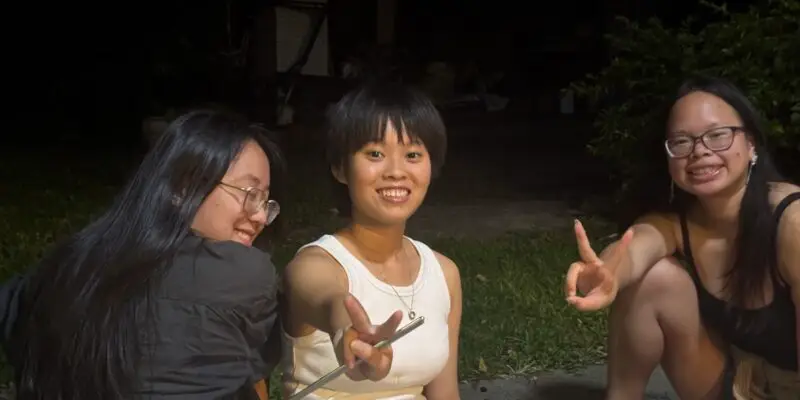
China, Hangzhou, roommates,
To be honest, before the trip, my fellow students and I had started to get into a groove. Our daily schedules—what we were doing, and who we were seeing—were becoming, in a sense, normal. Our new routines felt comfortable, especially when we didn’t think that life so far from home could ever feel normal. The weekend was a break from that though, and it gave us a much needed reminder as to why it’s important and incredibly awesome to travel and to keep trying new things. Traveling, or just deviating slightly from your standard activities, can be exhilarating. When you come to China, try to make baozi (and discover after six attempts that you’re embarrassingly bad at rolling them). Or teach your fellow students and their Chinese roommates to play Hearts (and then turn that into a ginormous 12 person tournament where losers have to sing, dance and declare undying love to each other). Life here is more than studying in the traditional sense of the word. We’re in China not just to learn Chinese, but to enjoy the experience and to gain a greater cultural understanding as well. It was lovely that we really got a chance to do that this weekend. Plus, since it was so much fun, we’re all now newly inspired to study harder to master the language. Bonus points all around.

China, Hangzhou, food

Baozi we made

Until next time,
Char


‘Mo please!

Bookmark and Share
Written by Katie Whitcombe (United States Naval Academy), Student Correspondent
.

Beijing, like any other society, is comprised of people from all different back grounds:  rich, poor, disabled and healthy. The world is full of differences, and Beijing is a city that exemplifies difference. Many see Beijing where the East meets the West with the unique way Beijingers assimilate western concepts and ideas and put their own spin on it, or vice versa when foreigners come to find work and set up business within the Chinese culture. However, as a student, many of these social underpinnings are lost to me in the bustle of city life- it all seems to blend together. What is not though, is the wide gap between the handicapped and healthy of Beijing.

With this in mind, I sat in a clean room, with a huge window over looking one of Beijing’s quieter streets and went through a mental check list. Clothes all on? Check. Shoes off? Check. Ready to get the best massage for the best price ever? Check!

On a daily basis, walking through the streets of Beijing you will encounter beggars. In America, if you encountered someone homeless often times don a sign reading something like “God Bless You” to “Need money, no beer.” But the homeless in China are a much different sort. Some have signs, but most painfully and publicly show their lowly status through their disfigured, mangled or deformed bodies. It’s surprising how many people you can encounter in a day, and it makes me wonder how they make a living off just the few maos and kuais they get by the chance passerby. A lot of times I just don’t know how to react, I have never met anyone with the physical problems asking for alms on the streets of America. Yet, some do get by.

When I arrived at the massage parlor, one of the attendants shuffled to the anti-disinfection box and took out some clean towels, feeling for the quality to ensure he had the right one for the massage bed I was told to get on. Once prepared, I was told to take off my shoes and lie down. But this massage was unlike any other that I have ever had, because my dai fu (massage therapist) was blind. In fact, besides me and the building’s care taker, no one else could see. All clothes were kept on, and he used a towel to rigorously take out all the knots in my shoulder and back. In this way it was totally different than a Western massage, different but relaxing.


Many people cringe at the idea of going to someone blind to get a massage (按摩an mo is massage in Chinese) . How do they know what is clean if they can’t see? What if they don’t know what they are doing? But I can tell you the experience was amazing and I am glad I went. It not only was affordable (~$10USD) but it was really interesting to see into the lives of what being handicapped in China is like. As I got massaged I chatted with the attendants asking them about where they went to school, how they liked their job, etc. They also taught me different names for the parts of the body (like shoulder and back).  I learned about the Chinese policy that promoted giving jobs to those with blindness through massage parlors and massage trade schools. It was refreshing to see that despite disabilities, some people in China still had a chance to have a life and work. The people at the massage parlor were so inviting too. They seemed to know my every muscle and could tell easily where I was sore before I opened my mouth as well as other things in like that I lifted weights and ran just from where my muscles were most developed in my back and legs. After going to school for 3 years and then practicing for another 5 my dai yi seemed to be an expert of the human body.

A typical Chinese blind massage parlor, but not the one I went to.

It was such a great experience I plan to return for ‘mo.

Beihai Bound

Bookmark and Share
Written by Luke Wander (University of North Carolina – Chapel Hill), Student Correspondent
.

I’ll start with an embarassing fact: I’ve never been on a proper spring break beach trip. You know the one I mean, with shoddy hotel rooms and frisbees and sunburn and shameless flirtation and an obscene amount of beer. I’ve never done all that (by choice). So when I found out we were going to the beautiful blue waters of the South China Sea (those photos on the website are in no way doctored, right? wrong), I was absolutely buzzing. We arrived in Beihai, a beach-side city home to 1,500,000, small by Chinese standards but actually the fastest growing urban center in the world, at about 6 a.m. on a Monday, and, too early to check in to our hostel, we set out to find something substantial to fill our bellies with after a bumpy night (Chinese night buses are a great to travel, if you’re 5’5”, any taller than that, and you’ll wish your knee caps were detachable.) About halfway into a round of noodles, a man, about thirty with a smile like a loyal dog came into the restaurant and started chatting us up. It began as a typical conversation between CET’ers and a Chinese person:

You know Chinese?

Yes, we study in Beijing.

Wow, your Chinese is great!

Thanks, I mean, no it’s not, you’re too polite. 

What country are you from?

America.

I love America!

Blah blah.

Blah.

Blah!

What made this conversation different was the way Danny, as we would later come to know him, smiled and laughed and shared. He genuinely wanted us to enjoy Beihai, and as much as we had been warned about overly friendly strangers, we couldn’t help befriending Danny. Two nights later we found ourselves in Danny’s restaurant, crowded around a table full of noodles and beer cans and wantons and squid, all on the house, with Danny and his wife, Linda, learning how to say choice words in Canto-Mando, comparing Nick To to Harry Potter, and taking photos with Danny’s iPhone. The Danny adventure could have ended that night, but we insisted on treating them to a seafood dinner on our last night in town, which led to them treating us to a picnic the following afternoon. In all honesty, I’m glad we left when we did, as I’m not sure how much longer we could have maintained the neverending game of ingratiation that Danny and Linda were well-practiced in. In twenty years, when I’m getting fat off the comforts of middleagedom (knock-on-wood), I won’t remember the plane ride and the skinny dipping and the sandcastle competition and how the bus fare was 1.5元 (most inconvenient when loose change is hard to come by), but I will remember three things, two of which are Danny related. I’ll always remember the look on Danny’s 9 year-old daughter’s face when we gave her an English name, Rachel. When she said it for the first time, a giggle followed it out, reminding us all that she was every bit Danny’s kid. I’ll always remember the day we left, and how the owners of the hostel took our 300元 deposit and made us fork over another 120元 because four of our towels were “sandy.” Danny had come to pick us up for our picnic, and when he heard what was happening, a different kind of energy took over him, and he gave the hostel owner a piece of his mind. Later, he explained that the owners were Northerners, and by cheating us foreigners, they were giving Beihai a bad name. When he said this, only one thing came to mind. Carpetbaggers. Danny is just a good old Southern boy who hates no-good, rotten, penny pinching carpetbaggers. Lastly, I’ll always remember the way the people of Beihai stared at us. In Beijing, the staring is more disdain than anything else, as if they’re thinking there goes another foreigner clogging up the subway system. In Beihai, there was a well-established routine. If the passerby was older in age, he would just stare, mouth open, eyebrows arched. If he was younger, he would stare, mouth open, eyebrows arched, and add a poorly imitated “Halo!” and a wave, too boot. At first, it was a mystery, but in five days, we only saw five foreigners in Beihai, all at sites well away from where we stayed. Beihai thought we nine Americans, with our hammocks and our bikinis and our Beijing accents, were pretty special. The feeling was mutual.

1st Place Alumni Video/Blog Contest Winner: Happy Birthday CET!

Bookmark and Share

Congratulations to Jamie Fleishman for placing 1st in the CET Alumni Video/Blog Contest - to view the other winning entries click here.

Written by Jamie Fleishman (Brandeis University)

CET祝你生日快乐/Happy Birthday CET

After giving me an incredible linguistic and cultural immersion experience in Beijing, and helping me find my current job at the Yale-China Association through the alumni email list, I have a debt of gratitude to CET. However, more important than the tangible outcomes of my CET experience have been the intangible personal experiences that come with being in the CET family. That’s what this video is truly about.

Click here to view Jamie’s video.