Japan

Toggle view

Outings in Japan

Bookmark and Share
Written by Evyn Fong (MICA)
AICAD in Japan, Spring 2013 Student Correspondent
.
AICAD in Japan

I have no idea where I was when I took this. I somehow found my way home…

So, everyone who’s ever played pokemon knows that in Pokeworld, cars are totally unnecessary and the fastest way to get around is by bicycle. That’s pretty much Japan.

Biking around is the best (in my opinion, anyways!) way to sightsee, get exercise, practice your Japanese (you’re going to get lost…), and also get new places!

AICAD in Japan

Going across the Nagarabashi Bridge to Namba on bike.

I try to bike somewhere new… well, as often as possible. This usually happens by accident, since I am directionally challenged.

The most adventurous project I’ve undertaken so far is the 8-mile bike ride across busy roads, country roads, and technically not-bicycle-friendly roads into Namba. I’ve done it three times now, and I’m finally learning how not to get lost.

AICAD in Japan

Bike parking lot!

Biking in Japan is quite the experience. At first it seems like everyone is going to get hit by all the cars at the same time. Then you realize that using any kind of movement in Japan, including walking, is basically playing high-stakes Frogger. Everyone watches out for everyone else and does their best not to collide!

The types of bicycles here are also different. As opposed to American multi-speed, multi-gear bikes, the typical Japanese bicycle is far more retro-styled. There’s no gears, and it’s a far more.. relaxed? style of riding than I’m used to. Fun, though!

There’s tons of bike shops in Japan, as well. You can refill your tires for free at any of them, since they have pumps for free use outside the shops. Bike parking lots also abound in urban areas- make sure to park in these, or else your bike might get towed!

My favorite place to bike so far is to parks, though. I went to one called Ryokuchikoen, north of Aikawa last weekend. So fun!

bike1

bike2

bike3

AICAD in Japan

One mystery I solved since coming to Japan: How do Japanese people find their bikes in those gigantic parking lots where EVERY BIKE LOOKS THE SAME?! Answer: either you remember exactly where your bike is, or you spend like an hour looking for it.

Japanese Style and Western Influence

Bookmark and Share
Written by Evyn Fong (MICA)
AICAD in Japan, Spring 2013 Student Correspondent
.

Since I’ve been in Japan, one of the most interesting things has been the interaction of Western and Eastern cultures. Since the Meiji Restoration Era, in which Japan opened up its previously closed doors to foreign exchange, Japan has been actively trading influence and ideas with the Western world- 文明開化, (bunmeikaika) as it’s called here.
The exchange of ideas with the Western world brought a lot of significant changes to Japanese culture- many of which have been so assimilated to the Japanese lifestyle that they seem more Asian than Western to the modern eye.
One good example of this is seifuku, or uniforms- especially the iconic sailor uniform. Though it’s not so popular now, it’s still a major icon of Japanese culture, and is still seen in cartoons and comics. Uniforms nowadays still retain a Western influence, as seen in the common plaid skirts and blazers of the students around Osaka.

For one of our assignments in Lifestyles, I illustrated a few of the modern unif

Japan, MICA,
But even more so than the modern influence of Western style on Japanese culture, the original clash of cultures during the Meiji Restoration Era was even more interesting. Though Japan and Asia’s influence on the West, called Japonisme, is pretty well-known in Western culture, the influence of the West on Japan is much less known.
However, it resulted in some pretty amazing stuff.

Japan, AICAD

This style, which continues on throughout the ages, also exerts influence on hanga (prints) and illustrators to come. For example, 新版画(Shin-Hanga, new prints) and one of my favorite discoveries since coming to Japan- an illustrator by the name of 中原順一 (Nakahara Junichi). His style, often called the “birthplace of kawaii culture”, is a mixing of Japanese brushwork, print composition and styles, and Western ideals of beauty. I used this style in one of my recent assignments for the Lifestyle Illustration class I’m taking. The assignment was to do an illustration for each of the zodiac signs. I’ll put a brief explanation of each down here:

Japan, MICA
Virgo: Virgo’s my sign, so I kind of already knew what I wanted to do. The artist I used as a reference, Junichi Nakahara, was really well-known for doing work with princess-like characters and innocent maidens. I thought that fit Virgo really well, so I wanted to do a snow-white or sleeping-beauty-esque girl looking in the mirror admiring herself, in muted colors.
Japan, MICA
Scorpio: Scorpio was super interesting to research. I was really interested in the “sexy” nature of the sign and how that’s interpreted in Japan. When I asked my roommates what the sexiest piece of clothing was, they replied with “something that shows the shoulders”, and came up with a super flowy dress with really draped sleeves, about knee length in white crepe. I thought that was a super interesting contrast to our leather-clad buxom dominatrix in America, so I wanted to do an illustrated that showed the Japanese version of “sexy”.
Japan, MICA
Pisces: The things that really caught my eye when researching Pisces were “victimized” and “moody”. A popular fashion theme here in Japan is called “mori-girl”; kind of like an abandoned child in a forest, with lots of super-flowy clothes and pioneer prints. I was really interested in how introverted and emotional people are seen in Japanese culture; when I asked my friends, they replied that it was either cute or too shoujo-manga (comics written for young girls). So I used a hand position that signifies pouting or worrying, often seen in manga, for Pisces.
Japan, MICA
Gemini: When I first researched Gemini, I was really interested in the “mutability” of the sign. I was trying to think of some way to incorporate the twins aspect of the sign as well, as I’ve always wanted to illustrate that. I thought that illustrating the twins as schoolchildren, who have so many possibilities and options open to them in the future, would illustrate the varied nature and possibilities of the sign. I made their hair red to show gemini’s strong personality.
Japan, MICA
Leo: In Japanese culture, a strong sense of self is a very masculine personality. I wanted to combine that masculinity with the traditional tough Japanese housewife- particularly, old geisha and women from the island of Okinawa. So I put a kind of sexy, powerfully-posed woman in a really house-wifey setting holding a traditional spatula instead of the “sexy lady” wine glass. I used really muted colors because the drawing got too complex, haha.
Japan, MICA
Sagittarius: For Sagittarius I just had to do traditional Japanese archery- Kyuudou. There’s a kyuudou club at the college I’m attending right now, and I had fun looking at all the different outfits and accessories online. I wanted to do at least one in a pretty traditional setting, with super geometric prints, and I thought Sagittarius would be perfect for that.

Welp, that’s all for today! You all should google some of those keywords from today’s post- there’s some lovely art out there.


Program Excursion to Kyoto and Arashiyama

Bookmark and Share

Written by Lauren Nakasato 

Resident Director, CET Intensive Language and Culture Studies in Osaka

After living in a place for a number of years, you start to get used to your surroundings. Even the most spectacular can become a given, blending into the backdrop of your life, invoking no more than a fleeting afterthought as you speed through your daily routine, attending to The More Important Things demanding your attention. Kyoto is arguably the most historic, beautiful place in all of Japan, and 40 minutes away from OGU by train. Yet “go to Kyoto” may only make my To Do list once or twice per year. “It’s so far,” and “It’s too crowded,” are common excuses.

Cue the students. Our group this semester, as in most semesters, is incredibly bright, inquisitive, and educated. They have a deep interest in Japan and have studied Japan and Japanese for years. Yet no matter how much background someone has in Japanese culture and language, coming here for the first time is an eye-opening experience. Everything is new, no matter how mundane. The opportunity to see Japan again and again through the eyes of the students reminds me of how lucky I am to live here.

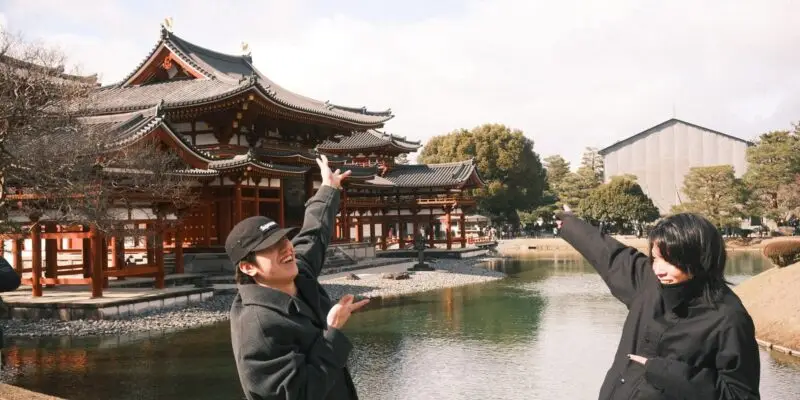
Saturday’s trip to Kyoto and Arashiyama was one such opportunity. Seven students and six Japanese roommates and I bundled up and rolled out to make Japanese sweets by hand and tour Tenryuji, a World Heritage Site and one of the most significant temples in Zen Buddhism. Though I take the trip at least once a year, I am constantly surprised by the newness of each experience, as if layers of meaning are uncovered with each trip. With my 14 new pairs of eyes, I watched colorful balls of sweet bean and rice flour become ornate tea-ceremony sweets, watched lazy carp cruise the waters of a tranquil Japanese garden, and watched powdery snow fall through the towering shoots in a bamboo forest, coming face-to-face with the scenes that I take for granted on a daily basis. And through the student’s eyes, I fell in love with Japan all over again.

Lifestyles- Train Station, Traditional Dress

Bookmark and Share
Written by Evyn Fong (MICA)
AICAD in Japan, Spring 2013 Student Correspondent
.

In order to better understand Japan’s fashion, current trends, and make the most of my time here while I’m not in the art college, I’m doing the projects from my college, Maryland Institute College of Art’s, Lifestyle Illustration class taught by the fantastic Daniel Krall. This week, our assignment was to do an illustration based around a certain place. It was really hard to pick between all the places I’ve come to love in these past three weeks, but I wanted to choose somewhere that really represented what I had come to associate with current Japanese fashion.

And of course, that ended up being train stations! Public transportation is just a part of life in Japan. The ratio of cars to people is much smaller here- people mainly use bicycles and trains. Since Japan is smaller, a convenience store is always about five minutes away.

.
I’ve found that the most interesting place to draw and study Japanese people is the train. A saying I just learned from my roommate Ai, “自分は自分” .(jibun wa jibun), literally translated as “myself is myself” is pretty accurate here. In the train, everyone is in their own world and pretty oblivious to whatever’s going on around them. You can see businessmen heading to work, college students heading out to party, elementary students on field trips, exhausted high schoolers frantically studying for tests.

.

The assignment I had, however, was to use existing fashion lines on models arranged in the place of our choice. I picked mainly non-mainstream lines from Japanese designers, but I had to stick in my favorite McQueen coat.
Japan, AICAD

I’ll also stick in a few train sketches. Click to enlarge!
Japan, AICAD

Japan, AICAD

Japan, AICAD


A few of the trends I’ve particularly noticed here are wool coats/huge puffy down coats with… miniskirts. And really high boots. It snowed today, and my roommate wore a miniskirt. Oh, japan.

.

Also, seems like pastels are really in right now, which makes me happy! I love pastels.

.

Another thing I was interested in is how schoolchildren use keychains and such to differentiate their uniforms. Since everyone has the same bag and clothes, the kids pick huge charms or accessories to jazz up their belongings. Hopefully I’ll get to draw this at some point!

.

Next, I did another piece using the girl with the red shoes. I really love the feeling of morning/afternoon Japan , especially in the countryside. ALSO I LOVE HOW CUTE THE LITTLE CHILDREN ARE oh my gosh (click to enlarge!)

AICAD, Japan

Last, we have to do new outfits for our models each week. This week, we did an event where we learned about traditional Japanese costumes, so that’s what I used! Thanks to my roommates for all their help with color picking!
Japan, Osaka

Japan, Osaka, AICAD

Japan, AICAD

AICAD, Japan
That’s all for today! I’m also going to start an outfit snap/sketch tumblr, so I’ll link to that when I get it up. Good night!