晓说 or Char Chats in Chinese: The Travel Edition
Traveling. Is. The Best. Yes, I know I’ve harped on it before. But I’ll say it again anyways: it’s so worthwhile and rejuvenating to get out and around. Going someplace new, I feel as I did when I first got here—excited and thrilled at the very fact that I’m in China. Case in point—our group trip this past weekend. While the Middlebury/CET program is certainly a grueling academic program (as our mountains of daily homework kindly remind us), we are also provided with a number of opportunities to explore China. In fact, CET gives us two weekends off (in addition to spring break) for school-sanctioned/organized trips.

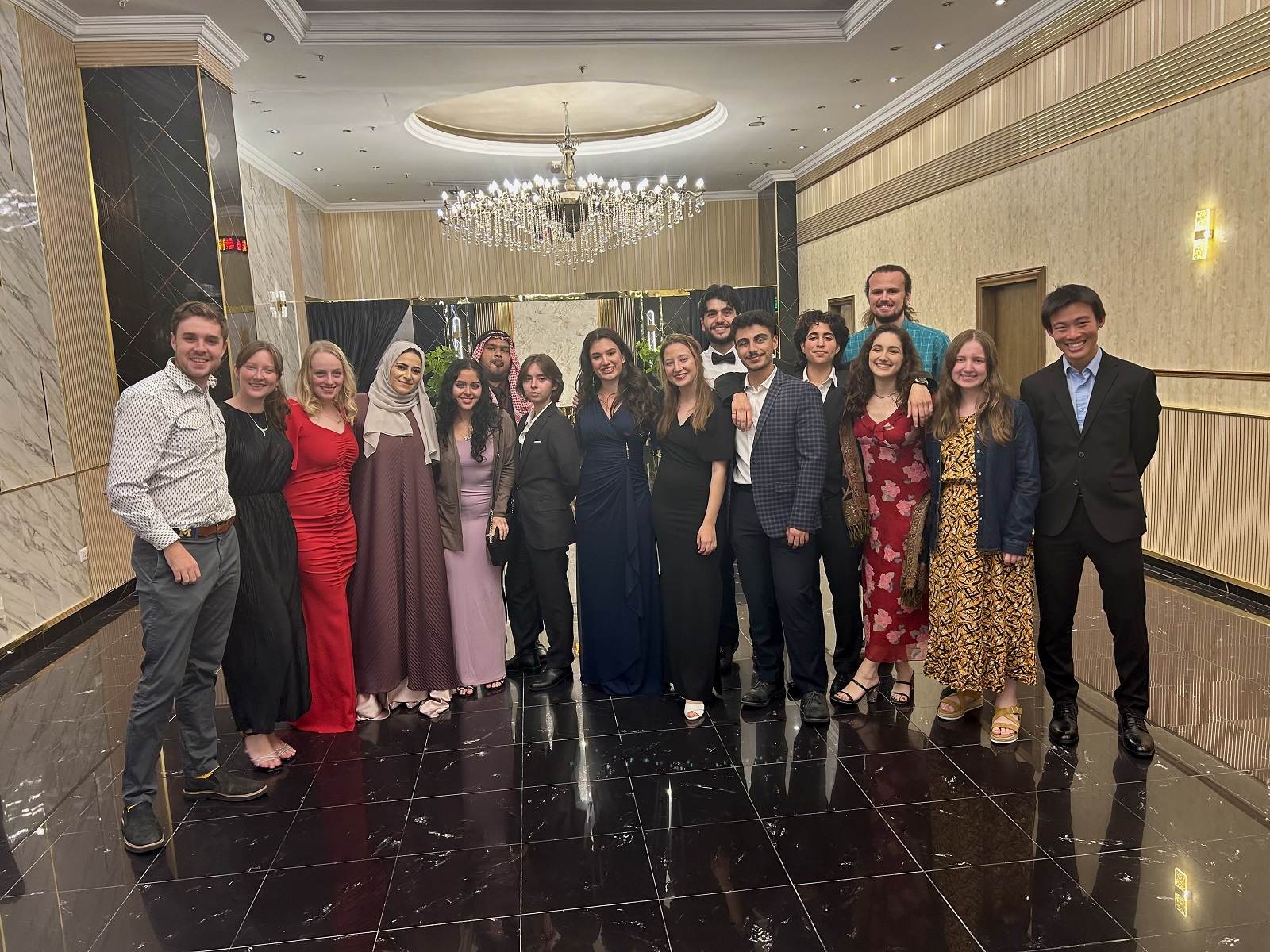
This past weekend felt a little like summer camp, or like those long ago elementary school overnight trips to places like Jamestown and Williamsburg. Or maybe it was more like one of those company bonding retreats we’ll all have to participate in when we finally find jobs five years after graduation. I don’t know… all I know is that the weekend was fun. We went hiking, played in waterfalls, swam in dirty rivers (on second thought, we probably shouldn’t have done that), and stayed up all night playing cards. We all—American students as well as Chinese roommates—became much closer on the trip.

To be honest, before the trip, my fellow students and I had started to get into a groove. Our daily schedules—what we were doing, and who we were seeing—were becoming, in a sense, normal. Our new routines felt comfortable, especially when we didn’t think that life so far from home could ever feel normal. The weekend was a break from that though, and it gave us a much needed reminder as to why it’s important and incredibly awesome to travel and to keep trying new things. Traveling, or just deviating slightly from your standard activities, can be exhilarating. When you come to China, try to make baozi (and discover after six attempts that you’re embarrassingly bad at rolling them). Or teach your fellow students and their Chinese roommates to play Hearts (and then turn that into a ginormous 12 person tournament where losers have to sing, dance and declare undying love to each other). Life here is more than studying in the traditional sense of the word. We’re in China not just to learn Chinese, but to enjoy the experience and to gain a greater cultural understanding as well. It was lovely that we really got a chance to do that this weekend. Plus, since it was so much fun, we’re all now newly inspired to study harder to master the language. Bonus points all around.
Until next time,
Char
3rd Place Alumni Blog/Video Contest Winner: The Road Less Traveled
I am always proud to tell people I studied abroad in Harbin, because I know how unique my experience there was. Some people may know Harbin for its famous ice-sculpture festival, or its Siberian tiger park, but I was far more than just a tourist there.

The Saint Sophia Russian Orthodox Cathedral was built by the Russians in the early 20th century when they ruled over the northeastern part of China. They say that at the time it was built, the cathedral was the last man-made structure standing between China and the Arctic Circle.
Dongbei, China’s northeast where Harbin is situated, evokes images of Siberia, an old industrial heartland, and factories belching out smoke on the vast northern Chinese plain. The wild, horse-mounted Manchus conquered China from here, and did not allow Han Chinese to migrate to the region until the turn of the 20th century. It is a wild place unknown to most Western observers, a city clinging to the Songhua River in the middle of the steppe, the last frontier town between China and the Arctic tundra. How many college students can say they have lived here, and taken a program trip to climb the last steps of the Great Wall as it ends against the North Korean border? How many could travel with Chinese roommates to the Five Great Lakes, staying in a People’s Liberation Army barracks on a volcanic plain, amidst brilliant autumn colors set against the black of the molten rock?

During the middle of the fall semester, CET took us to stay for two nights on Daludao (Stag Island), a small island in the middle of a tributary feeding the Yalu River, which forms much of the border between China and North Korea. Our first day there, we strolled across the beeches at low tide where we came across many Chinese fishing junks like this one run aground on the sand.
Before I had learned how unique the setting was, I had decided to come to Harbin to make my Chinese the best it could be. In this, CET was also an incredible success. The classes were challenging and specially tailored to our interests and abilities, but the Chinese roommates we lived with for four months were by far and away CET’s greatest gift to us. We woke up speaking Chinese, learned all the colloquialisms of Chinese college social life, and experimented with the local dongbei dialect, laden with warmth, charm and an irrepressible humor. Through connecting with our Chinese roommates we were ushered, if we were lucky, into the sheltered confidence of the Chinese group almost always forbidden to foreigners. I have been back to China multiple times since study abroad, but I have rarely felt as connected to the true pulse of a people as I did in Harbin.

Chinese and American roommates knee-deep in the sand at Daludao. The mid-semester trip with the Chinese roommates was a fantastic way for us to bond while exploring the untamed wilds of the North Korean border area.
I will also never forget the connection I developed with the city and the adventures that I had there. In Harbin, to keep warm during the Siberian winter we often clung to roasted sweet potatoes as we strolled on the outskirts of campus. Spending an autumn evening kicked back outside eating Xinjiang roasted meats was our favorite way to unwind after a long day of classes; we ate dog hot pot, because you can do these things in Harbin; we sampled the warming borscht at each of the Russian restaurants lining the cobblestoned promenade of the old Russian-built Harbin city center. After classes, we ran laps and did high kicks in the basement of a Soviet-era gym as our Shaolin Long Fist teacher sat back and laughed at us, crooning to his little white dog. We went out to the night clubs and bars peculiar only to a city like Harbin, where in scenes reminiscent of the Cantina band in Star Wars we mingled with what seemed like an intergalactic assembly of people – electronica-loving Russians, cognac-sipping Frenchmen, as well as Koreans, Kenyans and Poles – all brought together in the warm interior of a frozen Siberian town. Yet we were the only Americans in Harbin. That was another of CET’s greatest accomplishments: creating a special bond between a disparate group of American students that became the sole representatives of their country in a city of 10 million people.

A view of North Korea through the battlements of the Hushan (Tiger Mountain) section of the Great Wall, the final stretch before China runs up against the North Korean border. The fields and mountains of North Korea turned out to be startlingly beautiful, completely untouched by the industry of the modern era.
The people, the city of Harbin, and the program that wove those into an amazing study abroad experience – in my time in China, those have made all the difference.
Okayama
Today, I’m going to do that travel blogging thing and actually blog about, well, travel. A couple weekends ago, we went on the overnight trip sponsored by CET to Okayama and Kagawa. It was AWESOME. All of us Americans and almost all of our Japanese roommates piled onto a bus early Saturday morning and drove to Okayama Prefectural Shizutani Educational Center, up in the mountains two prefectures to the west of Osaka.
The Educational Center is a big building with classrooms, a cafeteria, baths, and these big tatami-mat floored rooms full of futons for sleeping. Japanese schools take their kids on trips to places like these to do group bonding activities, learn random skills, and generally have some good clean fun, so it was a cool opportunity for us to have a similar experience. Right when we got there, we got a talk about the rules and regulations about staying there (like how to fold our futons properly) and dropped our stuff before lunch in the cafeteria.
The Educational Center is also right next to the beautiful old campus of the Shizutani school, which is one of the oldest schools still around in Japan. Its history goes back to the early Edo Period (1660s). The main lecture hall building by itself is OLDER. THAN. THE UNITED STATES OF AMERICA. Yikes. A lovely guide gave us a tour of the grounds (even got a chance to pray at the school shrine) and we had some free time to wander.
After a brief foray in search of civilization (we were really out in the boonies), which yielded the delicious results of soy sauce ice cream (surprisingly tasty), we headed back to the school for a lesson in making Bizen-yaki! Bizen-yaki is a specific type of pottery unique to the Bizen region (in which we were staying). We got a brief how-to tutorial from the Bizen-yaki-sensei-in-residence and then they gave us our own globs of clay and a mini-wheel and off we went! I made three little teacups.
Once we cleaned the clay off of our hands, we headed back downstairs for dinner. Then, after dinner, we had the baths all to ourselves for two whole hours. For most of us Americans, it was our first experience with a traditional Japanese bath (a large room with showers along the wall to wash before soaking in the big tub of hot water in the middle), but it was significantly more fun and less awkward than I imagined. We ended up having a grand time being silly, singing Disney songs, and splashing around in the big tub. Afterwards, it was great to just bum around the rooms, play cards, and be silly before an early bedtime.
We woke up bright and early on Sunday to eat breakfast, fold our futons, and generally make our rooms and bathrooms spiffy before we got back on the bus on our way to Kagawa. We stopped for lunch and wandering in Kurashiki, and then back on the bus, headed to Kotohira, in Kagawa Prefecture on Shikoku (the island right to the south of Honshu, the main island).
We climbed the 1,000 steps to Konpira shrine on top of a mountain, during the peak of the cherry blossom’s beauty. Between the gorgeous trees and beautiful vista every time I looked behind me and watched the city fall away beneath us taking my breath away every five seconds, and the 1,000 freaking steps, I’m amazed I made it to the top alive. What an awesome opportunity.
After we all made it back down the mountain, we went to a school for making udon and learned how to make the dough and roll out and cut our very own udon noodles! It was a blast. Half of the process of making the dough is, after you mix it, you put it in a plastic bag and then dance on it. So, naturally, the Sensei put on some silly pop music and we boogied like pros. They fixed us some tasty tempura and we cooked the udon we made ourselves. I’m not sure whether it was that the udon ingredients were especially good, or that we’d climbed 1,000 steps that day, or that we made it ourselves, but those were the best noodles I’ve had in a very long time.
Exhausted, well-fed, and quite pleased with an excellent trip, we piled back on the bus and slept the whole way back to Osaka.
More than Memories
Written by Mark Lenhart, Executive Director
CET Academic Programs - Celebrating 30 Years of Education Abroad
Think of the last time you visited a place that holds powerful memories. When you visit your old high school, for example, you expect things to seem different. You know the building will look smaller than you remember, or the teachers will look younger. What you don’t expect is how visiting can call forth long-forgotten memories—how you find yourself remembering whole conversations simply by wandering into a particular classroom. Despite 25 years of drastic change, Beijing still does this to me.
During the fall of 1987 and spring of 1988 semesters, I attended the CET Chinese Language Program in Beijing. Like all CET graduates, I have fond memories of my time abroad. Today I serve as CET’s Executive Director, so unlike many alumni, I have the unique opportunity to revisit my memories on my regular trips to China.
It always starts with my Chinese. When I step out of the Beijing airport to catch a cab, I usually worry about my speaking ability: are the right words and tones still there? Quickly it comes back, and after a 45-minute conversation with the cab driver, I regain confidence. Two or three days into my trip, some gate opens, and memorable phrases start to flood my mind. Zhǐ yào nǐ guòde bǐ wǒ hǎo, was a song lyric my friend Kang Erxu always said to me as a joke, each time he said goodbye. I remember hearing my friend Shu Haijun ask for a bathroom near Tiananmen, probably in the spring of 1988: “Nǎ’er yǒu cè suǒ?” That seemed so much better than the definitive “Cè suǒ zài nǎ’er?” we learned in beginning class, and it stuck. “Shy Like an Angel,” a pop song from 1987, was wildly popular despite its chorus sung in English. My Chinese friends jokingly sang it as “Shā le nǐ wèi gǒu” or “I’d kill you for a dog.” The tune and the joke pop into my mind every time I return to Beijing.
Certain buildings do the same thing, as I discovered during my visit to Beijing last week. Here is the Shangri-la Hotel, newly opened in 1987, where I regularly taught English to a group of hotel staff in the spring of 1988. There’s the Xiyuan Hotel, where CET students might splurge and buy a Cadbury bar with the strange Foreign Exchange Currency (FEC) that no longer exists. There’s the Ganjiakou Mall, which replaced the state-run department store, which replaced the green stalls that free market pioneers assembled when I was a student. Ganjiakou is where I struggled with my 200-level Chinese to buy a towel, without knowing the word “máo jīn,” on my very first weekend in China.
And then there are the people. Many of the teachers and Chinese roommates who have taught CET students over the years keep in touch with me. This time I visited a group of five retired teachers in Harbin, including 90-year-old Ma Ning Laoshi. Ma Laoshi, who speaks Russian and Japanese fluently from the old days, has been a much-loved mentor for dozens of CET students. Over lunch these teachers laughed and reminisced about the CET students who stood out: the one who decided to join a Chinese monastery (Ma Laoshi talked him out of it); the one who created a strange necklace out of his wisdom teeth; the one who actually took Zhou Laoshi’s advice and learned a new chéng yǔ (proverb) every single week. These students were wonderful because they asked such great questions, the teachers said. Claiming to have learned as much as they taught, these teachers reminded me that the CET programs often affect our hosts as much as they affect our students.
As CET celebrates its 30th anniversary, and as we all look back, here is my wish for our students: that the memories forged while studying abroad stay in the forefront of your lives through continued contact with your roommates and teachers. We are delighted every time we hear that a CET graduate works abroad, uses the new language in his or her career, or returns to the host country for business or pleasure—and many of them do!
We hope you will join us in Washington, DC or Beijing this year as we celebrate our anniversary and raise a toast to thirty years of (more than) memories.
To read more 30th Anniversary blog posts click here


CET Academic Programs