
Our goal is to offer every course every term, but sometimes factors like faculty availability and program enrollment keep us from reaching that goal. If you’re concerned about needing to enroll in one particular course, please contact us!
CET Harbin Study Abroad
CET Harbin is suspended until Spring 2025. Students looking for another intensive Chinese language program can explore CET Beijing or other programs in Greater China.
CET Harbin: At-A-Glance
20 hours/week of intensive Chinese language
Personalized, semester-long one-on-ones
Full-time language pledge
Live with a Chinese student
One-on-two drills
& small-group classes
& small-group classes
Out-of-class learning and assignments
Overnight excursion to a new city
Previous slide
Next slide
Fall
- Arrival: 08/24/2023
- Departure: 12/10/2023
- Recommended Credits: 17
- Fee: $17,490
- Application Deadline: May 1
SPRING
- Arrival: 02/16/2024
- Departure: 06/01/2024
- Recommended Credits: 17
- Fee: $17,490
- Application Deadline: November 1
Fall
- Arrival: 08/24/2023
- Departure: 12/10/2023
- Recommended Credits: 17
- Fee: $17,490
- Application Deadline: May 1
SPring
- Arrival: 02/16/2024
- Departure: 06/01/2024
- Recommended Credits: 17
- Fee: $17,490
- Application Deadline: November 1
After several semesters spent studying Chinese in the US, it’s time to refine your skills with specialized classes and individualized instruction. CET Harbin study abroad students are experienced, dedicated learners who are striving for fluency and building confidence in their language abilities. With content courses, a self-designed One-on-One Tutorial, accuracy-focused One-on-Two Drill courses, a full-time language pledge, and a local roommate who brings language practice to life at home, it won’t be long before using Chinese is second nature.
Academics in Harbin
Semester
Snapshot
- Pre-requisites: 4 Semesters of Chinese
- 20 hours/week of Chinese learning
- Self-designed One-on-One Tutorials
- One-on-Two Drill courses
- Full-time language pledge
- Out-of-class learning & assignments
- Host University: Northeast Forestry University
Curriculum & Syllabi
CET Harbin offers two tracks: standard and research. The research track is available only to very advanced students with the approval of the Academic Director. Students take a One-on-One Tutorial, a One-on-Two Drill course, and two content electives to meet the recommended 17 credits.
One-on-One Tutorial
You choose your tutorial topic and the Academic Director works to find a suitable professor to assist with your studies.
- HB/LANG 400: One-on-One Tutorial (4 credits)
- HB/LANG 405: One-on-One Tutorial (7 credits, Research Track only)
One-on-Two Drill Course
You are placed into this 3-credit course with another student who is at the same Chinese level:
Note: Research track students do not take this class and instead take 7 credits of One-on-One Tutorial.
Content Course Electives
You choose two of these 5-credit content courses:
- HB/LANG 325: Conversation Seminar
- HB/LANG 330: Introduction to Classical Chinese
- HB/LANG 380: Business Chinese
- HB/LANG 410: Selected Readings in Modern Literature
- HB/LANG 413: Introduction to Chinese Newspaper Reading
- HB/LANG 430: Advanced Classical Chinese
- HB/LANG 490: Research Topics for Advanced Learners

Take your Chinese to the next level
Harbin as your classroom. Your One-on-Two drill course focuses on getting you out of the classroom to put your Chinese to work in the city. You might bargain for fruit at a local market. Or interview passersby about China’s payment apps. It’s all about fine-tuning your pronunciation and grammar in real world settings.
Content with context. Content courses go beyond learning vocabulary and grammar. Your Business Chinese class might interview a bank manager about financial development in China. Your Classical Chinese class might visit a school emphasizing traditional Chinese culture.
Design Your One-on-One
Choose a topic and the CET Harbin Academic Director handpicks a professor to guide your studies for the semester. Learn the technical vocabulary needed to delve deep and begin projects that could develop into a thesis topic or graduate research once you’re home.
Previous One-on-One Topics
- Belt and Road Initiative
- China's Feminism, Gender, and Sexuality Studies
- China's Ethnic Minorities
- Urban Development
- Chinese Environmental Conservation
- Chinese Ink Painting
- Chinese-Korean Relations
Housing and Meals
Previous slide
Next slide
- Dormitory
- On-campus housing
- Live with a Chinese student
- 2 people/room
- En suite bathroom, communal kitchen, paid washer access
- Paid wifi access, A/C, bed linens, basic furnishing, mini fridge
Living Like a Local
Local Roommates. Your roommate is a CET-selected student from our host university, the Northeast Forestry University. Sharing a room with a local roommate gives you instant insider’s access to the city. Learn more about living with a local roommate.
Eating in Harbin. For meals, take your pick of the budget-friendly campus cafeterias, try the nearby row of food stalls, or find your favorite neighborhood restaurant. And don’t forget to try disanxian (a potato, eggplant, and pepper dish) and da lie ba bread to get a delicious experience that is unique to northeastern China. Learn more about accommodating your dietary needs in Harbin.
*Note: In light of China’s COVID restrictions, the local roommates component of the program may not resume right away. CET will make every effort to make local students a part of the program, likely serving as language exchange partners and cultural resources.

Life in Harbin

- Known locally as: 哈尔滨 Hāĕrbīn
- Population: 10.6 million
- Local Currency: Chinese Yuan, aka renminbi
- Famous for: Harbin Ice Festival, Dongbei culture, standard Mandarin Chinese accent, very little presence of spoken English
Students come to Harbin for full immersion. In this second-tier Chinese city, you enjoy a population with fewer English-speaking foreigners, a textbook accent, and an entire city that can serve as your language classroom. Learn the names of all the street food vendors. Picnic on the Songhua River and chat with passersby. Visit the mosque in Old Harbin and ask about the architecture.
Experience China with CET
Around the city. Spend an evening singing karaoke with your roommate. Shop for souvenirs in the Hongbo underground mall. Take a taijiquan (taichi) class. Visit the Daowai district to eat traditional Harbin foods and explore the Baroque architecture with a uniquely Chinese feel. Explore Stalin Park and learn about the city’s Russian influences. The location of Harbin offers a Chinese experience like no other.
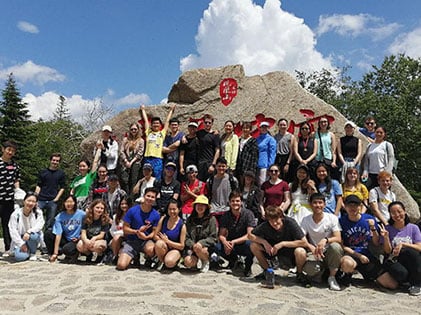
A Weekend Away. Take a break from intensive language study to explore China outside of Harbin’s city limits. You might visit Beidaihe to enjoy the relaxing hot springs and spend a little time on the coastal beach. Make sure to see Laolongtou (“Old Dragon Head”) where the Great Wall meets the sea. Enjoy worry-free travel with CET-hosted experiences that let you unwind while exploring with fellow students and local roommates.
Previous slide
Next slide
Student Resources
"After two full semesters of CET Harbin, I can attest to the benefit of the language pledge in my Chinese. I'm comfortable in conversations and have a foundation to build on in the future."
— Samuel Hubbard,
Washington State University | Academic year student
— Samuel Hubbard,
Washington State University | Academic year student
"The most important outcome of my term abroad was the improvement in my language ability from very limited to fully conversational. I know I can continue to improve by engaging with materials meant for native speakers, like newspapers and movies."
— Anonymous Final Evaluation
Spring student
— Anonymous Final Evaluation
Spring student
Previous slide
Next slide
On-site Staff

Ren Shujing
Academic Director
Program Fees
Fall/Spring
$17,490
What's Included
Tuition
All of your classes and program-related learning are included with your tuition.
Housing
We arrange for you to live in a dormitory with a local roommate. Your program fees go toward rent, furnishing, and other management costs.
Staff Support
From pre-departure to orientation, from on site to re-entry, CET provides you with the support you need every step of the way.
Visa Fees & Support
We guide you step-by-step through the visa process. You’ll need to do the legwork, but we pay the consular fees if you obtain your visa through the service we recommend.
Insurance
You’re provided with a comprehensive insurance plan through GeoBlue that even includes medical evacuation coverage.
Activities & Excursions
The activities and excursions that we arrange are included in your program fee. All you need to do is remember to bring your camera!
Course Materials
Your textbooks and course supplies are covered and waiting for you on site.
Transcript
You’ll receive an official transcript jointly issued by CET and NFU. If your home institution requires a School of Record transcript, CET is able to provide one through the University of Minnesota.
More on finances
Program Fee Breakdown. Of the total program fee, $14,800 goes to tuition and fees, and $2,690 goes to housing and other student life fees.
Local Cost of Living. Day-to-day cost of living in Harbin is generally cheaper than that of most places in the United States. Within China, Harbin’s status as a second-tier city means things are often cheaper than in Beijing or Shanghai but can still vary greatly depending on your lifestyle.
Estimated out-of-pocket expenses:
- Round-trip Airfare: $1,300 - $1,900
- Meals: $1,200
- Personal Expenses: $1,200
- Dormitory Wifi: $20
- Local Cell Phone Plan/SIM Card: $200
additional resources
How to Apply
CET Harbin is suspended until Spring 2025. Students looking for another intensive Chinese language program can explore CET Beijing or other programs in Greater China.
Eligibility
- • Pre-requisites: 4 semesters of Chinese or the equivalent
- • Must be 18 or older at the time of program participation.
- • Open to students from any US college or university
- • GPA: 3.0 or higher preferred, but admissions decisions are made on a case-by-case basis; lower GPAs still encouraged to apply
Online Application Form
Complete the application through your online CET account. This is a brief form that asks for basic information and has a few short answer questions about why you want to study abroad.
Passport Information
Upload a scan of your passport to your online CET account. This should be a single scan that includes the signed signature page and the photo/personal details page. Don’t have a passport yet? Let us know and we can help advise you.
Language Evaluation Form
Though you take an in-depth placement exam on site, the language evaluation form in your online CET account helps staff get a better idea of your abilities before your arrival.
Language Level Recommendation
This is an online form that your current or most recent language instructor completes to help us get an idea of your language level. Use the link in your online account to send the recommendation request.
Study Abroad Office Recommendation
This is an online form that your study abroad office completes to let us know you meet the requirements to study abroad. To send the electronic form request, simply enter the name and email address of your study abroad advisor in the designated fields of your online account.
Official Transcript
Your online CET account has specific instructions for submitting an official transcript.
Application
Deadlines
Fall Semester:
May 1
Spring Semester:
November 1
Have a question? Get in touch!
Annie Belleville
Student Services Coordinator
202.846.7648
[email protected]
Price Subject to Change:
CET reserves the right to increase quoted charges at any time without prior notification, based on increased instruction costs, exchange rate fluctuation or other cost increases beyond CET’s control.